A Layered Detection Pipeline for Automated Play on the partypoker Network
Empirical detection is not implemented as a single decision rule. The present document describes a pipeline of four stacked layers, each acting as a weak classifier and progressively narrowing the candidate population prior to human review.
Short answer. Modern detection on a shared-liquidity poker network stacks four kinds of signal — client/environment checks, input biometrics, gameplay statistics and network-graph analysis. No single layer convicts an account; together they shrink millions of accounts down to a small flagged set that humans review. The network's pooled data makes the last layer, the graph, especially strong.
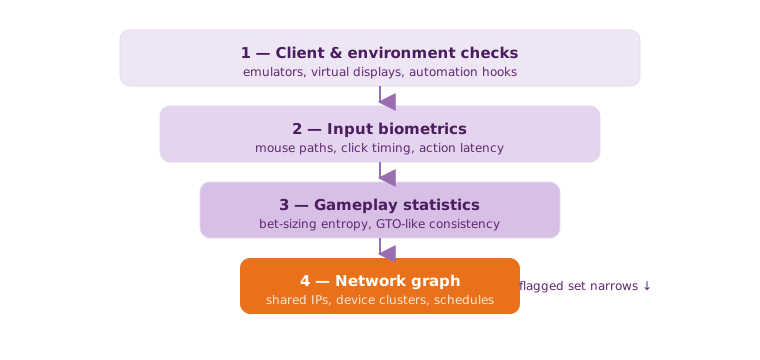
The four layers
Client & environment
The client looks for emulators, virtual displays, injected libraries and automation hooks — the scaffolding bots run on. Cheap to run, easy for sophisticated bots to evade, so it's a filter, not a verdict.
Input biometrics
Mouse trajectories, click timing and how reaction latency varies with situation. Humans are noisy and context-dependent; naive automation is suspiciously smooth or suspiciously uniform.
Gameplay statistics
Bet-sizing entropy, frequency consistency and how closely play tracks a solver across thousands of spots. A human drifts; a bot tends to be too consistent, too long.
Network graph
Shared IPs and devices, correlated schedules and chip-transfer patterns. On a pooled network this layer is the strongest — it links accounts no single hand would.
Why "looking human" isn't enough
It's common to assume that humanising inputs — jittered mouse paths, randomised delays — defeats detection. It defeats one layer. Layers three and four don't care how the click looked; they care that the decisions are too consistent and that the account sits in a cluster with others. On a shared-liquidity network those last two layers feed on the whole pool, which is exactly why this network is a hard place to run automated play undetected.
None of this is a how-to. It's a description of why the architecture and the maths line up against automated accounts here. If you're researching integrity on this network, talk to us.

Raul Moriarty — Poker Software Expert
Writes about online poker integrity, network architecture and game-security tooling.