Shared Liquidity and the Detectability of Automated Play on the partypoker Network
This document examines the partypoker / MPN shared-liquidity architecture and characterises its principal consequence for automated play: a single pooled traffic stream is observed by a single integrity layer, and correlations exploited for classification are computed at the network level rather than per skin.
Short answer. partypoker runs a shared-liquidity network — historically the Microgaming Poker Network (MPN), now operated under Entain. Several front-end "skins" share one common pool of players, tables and tournaments. For automated play this is decisive: a bot is not hiding in a small room but competing inside a large pooled field that a single integrity system observes end-to-end.
What "shared liquidity" means
In a shared-liquidity network, the visible brand is just a skin over a common platform. When you sit at a table, the other players may have joined through a different skin entirely — you all share the same tables, the same prize pools and, crucially, the same back-end risk and integrity systems.
This is good for players in one obvious way: bigger pools mean fuller tables and larger tournaments. It is the same pooling, though, that gives the operator a network-wide vantage point.
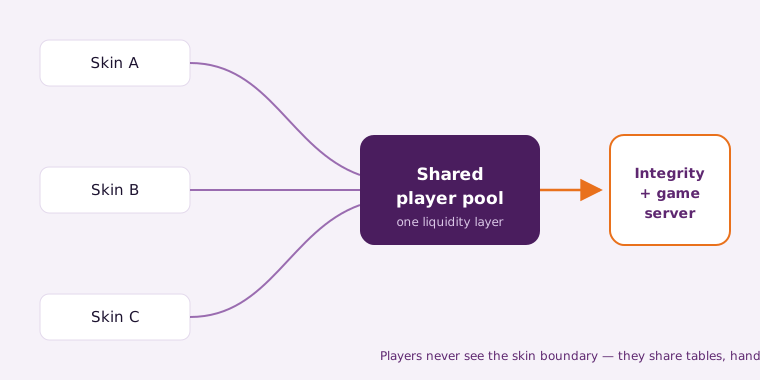
Single room vs. shared network — the practical difference
| Dimension | Single isolated room | Shared-liquidity network |
|---|---|---|
| Field size | Limited to that room's traffic | Pooled across every skin |
| Detection vantage | One room's data only | Correlated across the whole network |
| Account clustering | Harder — fragmented data | Easier — device, IP and schedule overlaps surface fast |
| Enforcement reach | One room | Network-wide; no sibling room to migrate to |
| Bot economics | Thinner volume | More volume, but a much sharper statistical fingerprint |
Why pooling helps detection
A bot's tell is rarely a single hand — it is consistency at scale: similar timing, similar sizing entropy, repeated schedules, and relationships between accounts. In a fragmented set of rooms those patterns are spread thin and hard to join up. On a shared network the integrity layer sees one continuous stream, so it can correlate behaviour and infrastructure across every skin at once.
The same scale that makes automated play tempting on a big network is what makes it detectable. The next page covers the specific signals integrity teams use, layer by layer.

Raul Moriarty — Poker Software Expert
Writes about online poker integrity, network architecture and game-security tooling.